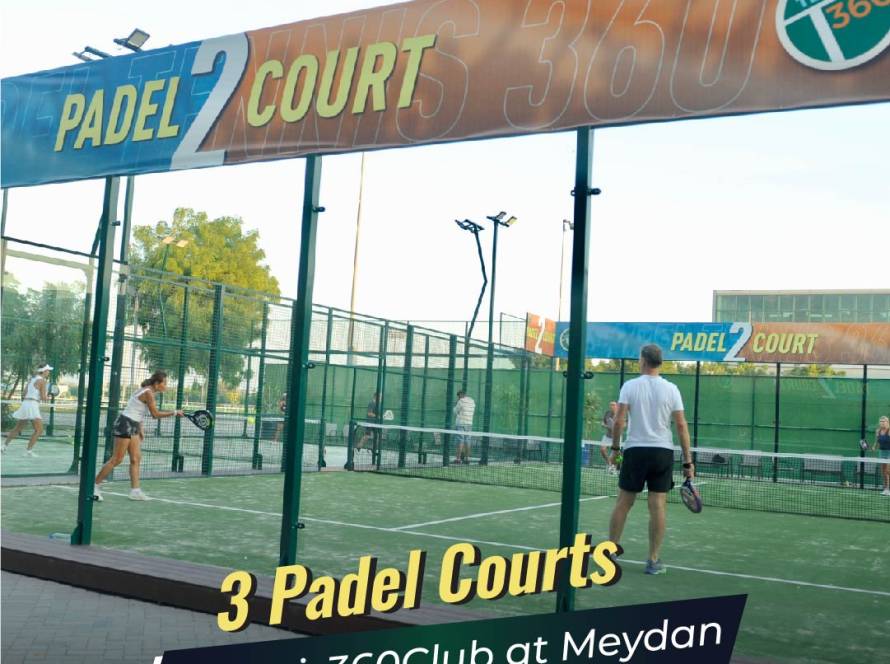
The 5 R’s in tennis are Ready, Read, React, Respond, and Recover. These five actions run on every single point, in that exact order. They are not five separate skills you practise once and move on from. One loop. From the split step to the final stroke, you are cycling through all five.
At Tennis Three Sixty, we use this framework with players at every level. It gives players a language for what goes wrong. When someone is struggling in a match, at least one of these R’s is the reason.
Ready: The Starting Point of Every Point
Being Ready is not just a stance. It is a habit. Weight on the balls of your feet, knees slightly bent, racket out in front. That position sets up everything that follows. Skip it and you are already behind.
The split step is the trigger. As your opponent makes contact, your feet should land at that same moment. That small hop loads your legs and lets you push off in any direction fast. We see players skip this all the time in drills. It costs a full second of reaction time. That is a lot.
How often do you reset your feet before your opponent makes contact? Most players do it for the first two points. Then they stop thinking about it. Ready is not a drill habit. It is a match habit.
Read: See the Ball Before It Comes to You
Most players watch the ball. The good ones watch the player. Reading in tennis means picking up cues before your opponent strikes. Their shoulder turn, stance, grip shape, and body angle all signal where the ball is going. This is where anticipation comes from. Not a gift. A skill. We coach players to shift focus from the ball to the opponent’s body just before contact. That shift alone can give you an extra step. Good reading is the base of any solid tennis strategy.
Think about a common rally moment. Your opponent squares up, opens their hip. That is a crosscourt shot coming. Read it and you are already moving. Watch the ball and you are flat-footed when it lands.
React: Your Body’s First Move
React is where hesitation lives. After reading the cue, your feet need to commit to a direction. That split second decides whether you arrive in time.
A fast reaction is not about physical speed. It is about mental commitment. Players who wait until they are certain before moving always arrive late. The first move does not need to be perfect. It just needs to happen. Want to train this specifically? Our guide on how to improve your reaction time in tennis covers the drills we use on court.
Respond: Play the Right Shot, Not Just Any Shot
Good position gives you options. Bad position gives you one. Responding is the shot selection phase. The quality of your shot depends on how well you executed the three R’s before it. Well-positioned, you can attack. Scrambling, your job is to keep the ball in play and reset the point.
Here is the decision logic we share with our players:
- Well-positioned, ball in strike zone: drive through it, go down the line, or take pace off
- Neutral position: cross-court, high over the net, deep bounce
- Out of position: lob, slice, or push cross-court to buy time
- Forced wide or behind the baseline: reset and survive, no low-percentage shots
Players who go for winners from bad positions have not yet mastered Respond. This thinking sits at the heart of any real tennis match strategy. And in our sessions, this is the R that produces the biggest shift when players genuinely understand it.
Recover: Close the Circle
Recover is the R most players skip. You hit a decent shot, you watch it for a moment, and your feet stop. Your opponent is already setting up their next ball. That pause hands the court away after one good stroke. Recovery means moving back to your base right after contact. Not jogging. Moving with intent. The centre of the baseline is where you want to be unless your shot pulled you forward. Once you recover, you are back at Ready. Circle closed. Loop starts again.
Sound familiar? We see this in almost every group session. Players admire their shots. Recovering is the habit that should be there instead.
How the 5 R’s Work Together
Think of the 5 R’s as a loop, not a list. Each R feeds directly into the next. A breakdown at any point affects everything that follows. Fail to read and you react late. React late and your position is wrong. Wrong position forces a bad response. A bad response slows your recovery. Then you are not ready when the next ball comes.
This is how we structure movement and decision-making work with our players at Tennis Three Sixty. One pattern we see constantly: players who think they have a fitness problem often have a reading problem. They feel rushed and blame their legs. Usually the issue is their eyes. Knowing which R is your weakest changes how you train. That is the real value of this tennis strategy framework.
Find Your Weakest R
Every player has a weak R in tennis. Finding yours is the first step to getting better. Book a session with our coaches at Tennis Three Sixty. We will work through all five R’s with you, on court, under match conditions. Ready to start?
Book a session or explore our programmes to find the right fit.