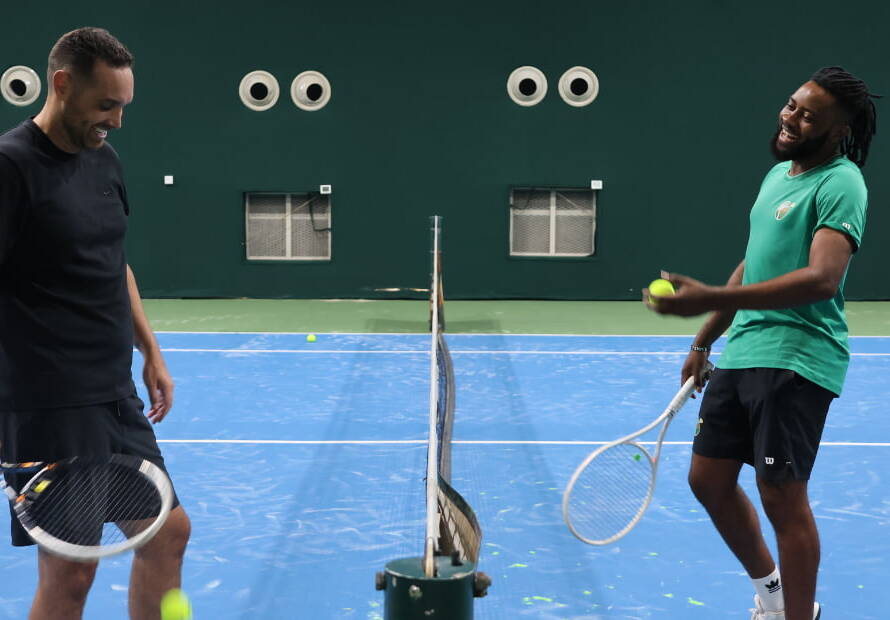
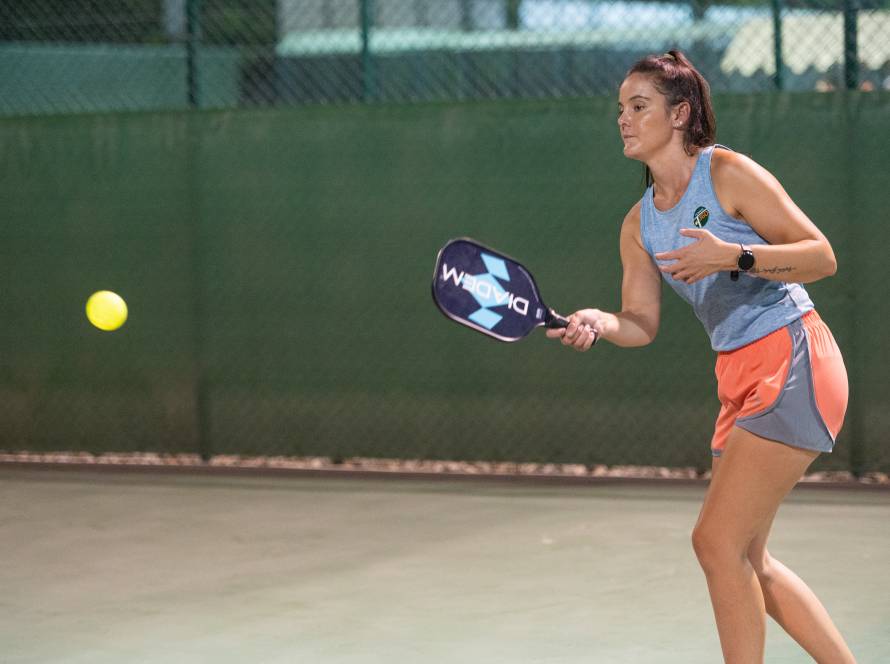
Padel court dimensions are fixed by international rules: 20 meters long and 10 meters wide. A net splits the court evenly down the center. That number holds steady across every court in Dubai and the rest of the world.
At Tennis 360, our padel courts follow this exact layout. What you play on here matches any club abroad. This guide breaks down the full size, wall heights, and net rules. It also compares padel court size to a tennis court. Maybe you are booking your first session, or brushing up before a match. These numbers explain why the game plays the way it does.
Standard Padel Court Dimensions
Measuring a padel court starts with two numbers you will see everywhere: 20 meters by 10 meters. Standard padel court dimensions place the total playing area at 200 square meters. That splits into two 10 by 10 meter halves on each side of the net. In feet, that works out to about 66 feet long and 33 feet wide. Official rules allow a small tolerance of half a percent in either direction. Courts get built by hand, so small gaps happen.
- Length: 20 meters (65.6 feet)
- Width: 10 meters (32.8 feet)
- Total area: 200 square meters
- Build tolerance: ±0.5%
That means a court anywhere between 19.9 and 20.1 meters in length still passes inspection. This tolerance matters more than most players realize. A club claiming regulation size should sit inside that narrow range, not somewhere close to it. At Tennis 360, every court we run sits within FIP-approved measurements. Rallies feel the same whether you play here or at a tournament in Spain.
Wall Heights and Court Enclosure
A padel court is not just an open rectangle like a tennis court. Walls surround the entire playing area. The ball can bounce off them and stay in play. The back walls stand 4 meters tall in total. That is 3 meters of tempered glass, topped by 1 meter of mesh fencing. Side walls follow a similar pattern. They hold 3 meters of glass, then narrow into mesh for the final meter near the net.
- Back wall height: 4 meters total
- Side wall height: 4 meters total, tapering to mesh near the net
- Wall material: tempered glass to 3 meters, mesh above
That wall height is not decorative. It is what makes long rallies possible. A ball headed out of bounds can still come back into play off a rebound. Coaches at Tennis 360 spend real time on glass reads with intermediate players. Judging a rebound angle takes far more practice than judging a straight groundstroke. Get that read wrong once, and the point is over before you know it. Need proper information about padel court dimensions? WhatsApp us and we’ll walk you through it. Or email us, and we’ll get back to you the same day.
Net Height and Service Line Specifications
A tennis net sits lower than a padel net, though the difference looks small on paper. Padel nets stand 88 centimeters high at the center. They rise to 92 centimeters at each post. That small lift at the posts keeps the net taut. It stops the ball from clipping the frame during fast exchanges.
Service lines sit 6.95 meters back from the net on both sides. That marks the zone a server must stand inside during play. Step past that line before contact, and the serve is a fault. It does not matter how clean the shot looks.
New players often serve from memory of a tennis baseline. That baseline sits much farther back. That habit costs points early on. We walk every beginner through service positioning during their first lesson at Tennis 360.
Padel Court vs Tennis Court Size
Most tennis players assume padel courts are just a smaller version of what they already know. The gap is bigger than that assumption suggests. A tennis doubles court runs 23.77 meters long and 10.97 meters wide. That gives roughly 261 square meters of play. Padel court size comes in at 200 square meters, a drop of close to twenty-three percent.
Less ground to cover changes the whole rhythm of a match. Rallies run longer, since walls send the ball back into play instead of ending the point. Footwork changes as well, in ways players notice fast. Padel rewards short, sharp positioning over the long baseline runs tennis demands.
Plenty of our members switch between both sports across the week at Tennis 360. Most say padel took under an hour to feel natural. Understanding the smaller footprint is most of that adjustment.
Why Court Size Changes How You Play
Court size decides more about your game than most players think going in. A smaller footprint with four walls turns padel into a game of angles first, power second. You cannot simply outrun a ball on 200 square meters. On a full tennis court, that chase is still possible. Every meter counts, so positioning with your partner becomes the real skill early on.
New players lean on strength before they trust the walls. That habit slows their progress more than anything else. Once you start reading rebounds instead of avoiding them, rallies open up fast. Group clinics at Tennis 360 spend the first few sessions purely on this shift. It changes everything else that follows in your game. Why does this matter before your first match? Because a player who understands padel court dimensions beats a player who is only strong.
Book Your Padel Court at Tennis 360
Book a padel court with us and feel these numbers in person, not just on paper. Tennis 360 runs padel courts built to full FIP specifications at our Meydan location in Nad Al Sheba. We also run courts across our other clubs in Dubai. A 60 minute court for up to four players costs AED 160. A 90 minute slot runs AED 220. Booking online through Playtomic takes just a minute. Courts stay open from 7 in the morning until 10 at night, seven days a week.
If you are new to the sport, our Introduction to Padel program is the right start. It walks you through grips, positioning, and scoring across three sessions. Players moving up from beginner levels can join structured group classes. These classes track your progress level by level.